

[ez-toc]
At a Glance: The State of Mental Health in India
📊
National Statistics
• 1 in 7 Indians currently affected.
• 70-80% Treatment Gap (NIMHANS).
• 0.75 Psychiatrists per 100k people.
⚠️
Major Challenges
• Social Stigma: The “Log Kya Kahenge” barrier.
• Rural Divide: Limited access in 25k+ villages.
• Workforce: Critical shortage of trained experts.
🌟
Future Hope
• NSPS 2030 Strategy: India’s formal MoHFW goal to reduce suicide mortality by 10% through nationwide gatekeeper training.
• Warrior-Led Care: Transitioning from passive survival to Lived-Experience Peer Support active “Cheer & Support” networks.
• Community Resilience: Youth-led advocacy (like Suno Na) replacing clinical silos with Strength-Based empowerment.
Data Governance & Validation
Why Mental Health Matters Today
Mental health in India stands at a crossroads.
While awareness is finally rising among the youth and in urban centers, the vast majority of our population remains caught between a growing need for care and a historical wall of silence.
The staggering gaps we see in national data are not just numbers on a page. They represent a daily reality of stigma that continues to silence those who need help the most.
“
The Ground Reality
“This article is built on the Suno Na Initiative a journey through 25+ villages and 20+ schools. We didn’t just study data; we listened to the stories of 5,000+ individuals in Uttarakhand.”
Direct Field Insights
A Historical Perspective: The Evolution of Care
🌿 Ancient India: Holistic Roots
In ancient times, mental well-being was woven into daily life. Ayurveda addressed mind-body balance, while Yoga and meditation served as tools for mental discipline. Support was found in community healing, and the Gurukul system nurtured emotional growth alongside academics.
⛓️ Colonial Period: The Era of Asylums
The British era marked a sharp shift, replacing community care with psychiatric asylums. The Indian Lunacy Act of 1912 labeled patients as “lunatics,” stripped them of rights, and moved them far from society into hidden institutions.
“By legally labeling struggling individuals as ‘Lunatics’ for over 75 years, this era effectively criminalized mental illness. This is where the fear of social ostracization and the ‘Log Kya Kahenge’ barrier truly began in modern India.”
🇮🇳 Post-Independence: The Long Road to Rights
Mental health remained underfunded for decades until the Mental Healthcare Act 2017. This landmark law finally decriminalized suicide and guaranteed the right to care, though the rural-urban divide remains a massive challenge to overcome.
The Dark Era of “Custodial Care” (1900s – 1990s)
From Colonial Asylums to Medieval Torture Houses
ORIGIN
Modern psychiatry in India actually began as a colonial tool. The first asylums in Bombay (1745) and Calcutta (1784) were exclusive, built only for Europeans. For centuries, the history of Indian psychiatry was simply the history of building bigger warehouses for the “unwanted.”
⛓️ The “Medieval” Reality
By 1946, the Bhore Committee found healthcare “extremely unsatisfactory.” Decades later, the Supreme Court described hospitals in Ranchi as “medieval torture houses” places that had become “dustbins of society” for the unwanted.
⚖️ Judicial Intervention
From the 1980s onwards, PILs forced the courts to act. Landmark cases like Rakesh Chandra Narayan vs. Bihar forced the government to renovate these institutions and acknowledged that patients have human rights, not just a need for a bed.
📋
The NHRC & NIMHANS Shift (1997-2013)
The NHRC’s “Quality Assurance” report was a wakeup call. It revealed that most care was “custodial rather than therapeutic” meaning people were being kept, but not cured.
Mental Health Statistics in India
Behind every number is a human story waiting to be heard.
Approximately 200 million people navigating mental health challenges daily.
8 out of 10 people in India receive no professional care or counseling.
The Professional Shortage
0.75 / 3.0 (Target)
We need 40,000 more specialists to meet basic WHO standards.
50x Shortfall
Currently at 0.2 per 100,000 severely below the recommended safety net.
“These aren’t just digits on a page. These are students unable to sleep, farmers trapped in debt, and families carrying heavy burdens in absolute silence.”
📊 Detailed Prevalence Report
Breakdown of Mental Morbidity in India (Adults 18+)
Current
🛡️ Anxiety & Stress
Often undiagnosed panic and phobias.
🧩 Specialized Care
Represents millions needing intensive care.
📉 Mood Disorders
A leading cause of disability in India.
🚨 The Treatment Gap
8 out of 10 people get zero help.
The Urgency: Beyond these numbers are 150 million Indians. The gap between prevalence and treatment is the real crisis we must solve together.
🧩 The Full Spectrum of Mental Health
Breaking down Anxiety, OCD, and Stress-related disorders.
Neurotic & Stress-Related
Affecting about 3.7% of the population, these aren’t just “worries.” Anxiety include intense panic and phobias that can make daily life feel like a battle.
Obsessive Compulsive Disorder
While often joked about, clinical OCD affects 0.76% of adults. It involves persistent, intrusive thoughts and repetitive behaviors that significantly disrupt life.
Trauma and Severe Stress
About 0.24% of the population deals with PTSD a long-lasting reaction to severe trauma that requires specialized clinical care.
Why mention these? Because mental health isn’t just one thing. By understanding the data for Anxiety and OCD, we stop the stigma and start providing the right kind of help for the right problem.
Who Is Most Affected by Mental Health Challenges in India?
Mental health challenges do not affect everyone equally. Certain groups face higher risks, unique pressures, and greater barriers to care. Understanding who is most affected is essential for designing targeted interventions.
Students & Youth
Exam pressure, career uncertainty, and social media stress.
Women & Girls
Gender expectations, safety concerns, and postpartum depression.
Housewives
Invisible labor, loss of identity, and social isolation.
Farmers
Debt cycles, crop failure, and suicide crisis.
Healthcare Workers
Extreme burnout, long shifts, and trauma.
Police & Forces
Trauma exposure and high-stress isolation.
Teachers
Student expectations and admin pressure.
Transgender
Discrimination, exclusion, and violence.
Sex Workers
Stigma, violence, and health insecurity.
Breaking the Silence
Every group here shares one common challenge: Stigma. Recognition is the first step in untying the knot.
Focus Group 01
Students and Youth
⚠️ Why They Are Vulnerable
Young people in India face unprecedented pressure. The education system is exam-centric, competition is fierce, and the transition to adulthood is more uncertain than ever.
- • Academic Pressure: Board exams, competitive exams, and parental expectations.
- • Career Uncertainty: Limited jobs, high competition, and unclear pathways.
- • Social Media: Comparison anxiety, cyberbullying, and digital addiction.
- • Identity Struggles: Navigating family expectations while forming self-identity.
🌱 How They Can Be Helped
Key Statistics & Systemic Gaps
The numbers tell a staggering story: Student suicides in India have increased by over 50% in the last decade,
highlighting a desperate need for structural change.
Lives Lost in 2023
Face Depression/Anxiety
Schools with Counselors
Youth receive help
Focus Group 02
Women and Girls
“Women in India face mental health challenges rooted in systemic inequality, social expectations, and safety concerns.”
⚖️ Systemic Barriers
- •
Gender-based Violence: 40% face domestic violence, leading to lasting PTSD.
- •
Double Burden: Performing over 75% of unpaid care work globally.
- •
Social Expectations: Pressure regarding marriage, children, and “honor.”
- •
Limited Autonomy: Lack of control over career and personal choices.
🛡️ Paths to Support
India accounts for 36.6% of global suicide deaths in women a crisis demanding immediate attention.
Report Chronic Stress
Anxiety vs Men
Postpartum Depression
Focus Group 03
Housewives
“Housewives women whose primary role is unpaid caregiving are often invisible in mental health discourse, despite facing unique pressures.”
🌫️ The Invisible Struggle
- •
Invisible Labor: Unrecognized work (cooking, cleaning, caregiving).
- •
Loss of Identity: Defined solely as wife, mother, or daughter-in-law.
- •
Social Isolation: Especially acute in rural or joint-family settings.
- •
Financial Dependence: No personal income or decision-making power.
🤝 Restoring Value
🚩
Married women in India account for the largest share of female suicide deaths.
Focus Group 04
Farmers
“India’s farmers face a devastating mix of economic distress, climate uncertainty, and systemic neglect.”
🥀 Why They Are Vulnerable
- •
Debt trap: high-interest loans, fragmented landholdings, unpredictable income.
- •
Climate stress: crop failure, drought, unseasonal rain, groundwater depletion.
- •
Market volatility: fluctuating prices, exploitative middlemen, inadequate MSP.
- •
Rural isolation: limited access to financial support or mental health care.
🛡️ How They Can Be Helped
⚠️ 6.3% of all suicides in India occur in the farming sector a sector that employs nearly half the workforce. Rural economic stress is also a mental-health crisis.
Suicides in 2023
Linked to Debt
Rural MENTAL HEALTH Access
Focus Group 05
Healthcare Workers
“The healers are hurting. India’s healthcare workers face a silent epidemic of burnout, trauma, and systemic neglect.”
🆘 Why They Are Vulnerable
- •
Brutal hours: 72–110 hour workweeks; 8% exceed 12 hours daily.
- •
Emotional toll: Moral injury from resource constraints and patient loss.
- •
Violence: 84% of doctors fear assault; 67% face legal complaints.
- •
Pandemic scars: Lasting trauma from COVID-19 remains largely untreated.
🛡️ How They Can Be Helped
Key Statistics & Data
Report High Burnout
Suicides (2010–19)
Sought Mental Help
🚫 A 2025 survey by Debabrata Mitalee Auro Foundation found that 91% of doctors would discourage their children from medicine, reflecting deep systemic stress.
Focus Group 07
Police Personnel
“Police work in India is a chronic stress crisis marked by prolonged exposure to trauma, brutal hours, and systemic neglect.”
⚖️ Why They Are Vulnerable
- •
Trauma Exposure: Constant contact with violence, death, and disputes.
- •
Brutal Hours: Average workdays of 11–12 hours with unpredictable shifts.
- •
Isolation: Social life erodes due to high-demand schedules and public friction.
- •
Coping Mechanisms: 59% report using alcohol to manage extreme stress.
🛡️ How They Can Be Helped
Key Statistics & Data
High Operational Stress
Symptoms of Depression
Suicide Drop (Project Mann)
Focus Group 08
Armed Forces Personnel
“Military service demands constant readiness and exposure to trauma often endured in a culture of silence.”
🛡️ Why They Are Vulnerable
- •
Operational Stress: Combat exposure and high-stakes decision-making.
- •
Separation: Prolonged family absence and limited contact during deployments.
- •
Isolation: Remote postings in harsh terrain lacking basic amenities.
- •
Stigma: Fear of being deemed “unfit for duty” if help is requested.
🤝 How They Can Be Helped
Strategic Impact Data
Self-harm deaths (Decade)
Report Severe Stress
Veterans with PTSD
Focus Group 09
Teachers
“Teachers shape young minds, yet their own mental health is often hidden behind paperwork, politics, and poor pay.”
📝 Why They Are Vulnerable
- •
Non-teaching burden: Over 60% cite paperwork and fee collection as their top stressor.
- •
Work Hours: Average working week exceeds 50 hours among the highest globally.
- •
Administrative Pressure: Micromanagement and rigid inspections stifle classroom creativity.
- •
Low Recognition: Inadequate compensation and limited professional development.
🛡️ How They Can Be Helped
Key Statistics & Data
High Stress Levels
Vacant Positions
Work-Related Impairment
Focus Group 10
Transgender Community
“Transgender individuals in India face a cycle of systemic discrimination and institutional neglect from family rejection to barriers in healthcare.”
⚠️ Why They Are Vulnerable
- •
Family Rejection: High rates of being forced out of homes and denied education.
- •
Violence & Abuse: 66% report discrimination; 21% face physical or sexual assault.
- •
Gatekeeping: Mandatory psychiatric certification for care creates a cycle of dependency.
- •
Lack of Sensitivity: Rare access to providers trained in trans-specific mental health.
🛡️ How They Can Be Helped
Key Statistics & Data
Experience Depression
Face Discrimination
Chronic Stress Levels
Focus Group 11
Sex Workers
“Sex workers in India face intersecting crises: criminalization, stigma, violence, and systemic exclusion from the very healthcare meant to protect them.”
🚩 Why They Are Vulnerable
- •
Institutional Violence: Over 30% of violence is perpetrated by police despite the 2022 SC dignity ruling.
- •
Systemic Stigma: Refusal of treatment or judgment at hospitals leads to hidden healthcare needs.
- •
Forced Coercion: Poverty and trafficking-driven entry are massive predictors of mental distress.
- •
Economic Fragility: Loss of livelihood and exploitation by brothel-keepers during crises.
🛡️ How They Can Be Helped
Critical Data & Statistics
Psychological Distress
Violence by Police
HIV Prevalence (High Risk)
Final Outlook
The Bottom Line: From Mapping to Action
Mental health in India is a complex web where economic distress meets social expectations. Understanding these vulnerabilities is the only way to build effective, human-centric solutions.
Decentralized Care
Moving support from urban hospitals to village blocks and local community hubs.
Policy Empathy
Integrating psychological well-being into labor laws and agricultural credit safety nets.
Peer Healing
Empowering survivors and community members to lead the way in localized care.
Breaking Stigma
Normalizing help-seeking across all demographics to end the cycle of silent suffering.
Recognition is the first step. Ensuring no one walks alone is the next.
Field Report: Suno Na Initiative
Current Mental Health Challenges: The Ground Reality
“Statistics numb. Stories wake.”
During our walk through villages and schools, we sat with students, teachers, and parents. We didn’t just look at data we listened to fears, silences, and hopes. Here is what the ground taught us.
The Invisible Wall (Stigma)
- •
“Log kya kahenge?” – This one question stops help before it starts.
- •
Fear of labels – Families hide struggling members rather than risk being called “mad.”
- •
Generational silence – Many had never spoken about mental health. Ever.
Naming the Pain (Awareness)
- •
Depression vs sadness – “Everyone feels sad sometimes.”
- •
Anxiety vs weakness – Dismissed as overthinking or nervousness.
- •
Children’s pain – “What problems can a child have?” If you can’t name it, you can’t treat it.
Missing Lifelines (Access)
- •
Zero dedicated counselors in most government schools we visited.
- •
Teachers as first responders – willing but untrained.
- •
No referral system – even when a problem was spotted, they didn’t know where to send the child.
The Rural Realities
- •
Rural Crisis: Debt cycles and crop failure lead to silent suffering.
- •
Suicide: Students fear parents’ sacrifices mean nothing if they fail.
- •
Isolation: Tele-MANAS remains largely unknown in village blocks.
🏙️ City Lights & Silent Struggles
Comparing Mental Health Prevalence (Swipe to view full table)
| Condition | Rural | Urban | Metro |
|---|---|---|---|
| Total Prevalence | 9.5% | 9.7% | 14.7% |
| Psychosis | 0.4% | 0.4% | 0.8% |
| Neurosis (Anxiety) | 2.8% | 2.2% | 6.8% |
The “Metro” Multiplier
Living in a Metro city like Mumbai or Delhi nearly triples the risk of Neurosis compared to smaller urban areas. Large cities are the breeding ground for stress due to high competition and isolation.
“I saw students suffer for years. But I didn’t even know what to call it.”
— Teacher, Almora District
The Lesson: Awareness alone is not enough. We need Access, Training, and Cultural Change.
Critical Insight
Mental Health Treatment Gap in India: Why It Exists
Understanding why 70–80% of people with mental health conditions in India do not receive care is essential to solving the crisis. The treatment gap is not a single issue it is a system of barriers working together.
What Is the Treatment Gap?
The treatment gap is the percentage of people who need mental health care but do not receive it. In India, this makes mental health one of the most under-treated health challenges.
The Five Barriers
Fear of being labeled “mad” still stops people from seeking help. Families often hide mental health struggles to protect social reputation and marriage prospects.
Therapy typically costs ₹500–₹2,000 per session. Even when medicines are affordable, long-term treatment remains financially difficult for many families.
Many small towns and villages still lack mental health services. In cities, public facilities are often overcrowded and understaffed.
Many people do not recognize mental health conditions as medical issues. Depression is seen as sadness. Anxiety is dismissed as weakness.
India has only 0.75 psychiatrists per 100,000 people, making access difficult even for those actively seeking help.
The Awareness Gap: Services Exist, People Don’t Know
One pattern repeated throughout the Suno Na journey: Services exist but awareness does not. Many villagers had never heard of Tele-MANAS, India’s national mental health helpline, DMHP (District Mental Health Programme) services, or the rights guaranteed under the Mental Healthcare Act 2017. The gap is not only about services. It is about visibility, accessibility, and trust.
The Gap Includes:
- 📞 Tele-MANAS: India’s national mental health helpline
- 🏥 DMHP: District Mental Health Programme services available locally
- ⚖️ MHCA 2017: Rights guaranteed under the Mental Healthcare Act 2017
Economic Barrier
Funding Gap
India spends less than 1% of its health budget on mental health. In comparison, high-income countries allocate between 5-10%.
More resources are needed for:
- Training professionals
- Establishing facilities in rural areas
- Running awareness campaigns
- Implementing the Mental Healthcare Act 2017
Insurance Gap
Mental health was not covered under insurance schemes until recently. The Mental Healthcare Act 2017 mandated insurance coverage, but implementation has been slow.
Most Indians pay out-of-pocket for therapy. For a family earning ₹15,000-20,000 per month, a ₹1,000 therapy session is a significant expense. Without insurance, therapy remains a luxury for the middle class and out of reach for the poor.
School Mental Health Gap
In many high-income countries, school counselors are mandatory. The recommended ratio is 250 students per counselor.
Students spend their most formative years without access to mental health support. Exam stress, bullying, and anxiety go unaddressed. Early intervention proven to be most effective does not happen.
Policy Maturity Gap
High-income countries have been building mental health systems for over 50 years. India’s major policy shifts have come only in the last decade.
India’s mental health infrastructure is young. With sustained investment and focus, it can catch up. But this requires political will, budget allocation, and consistent implementation.
Why Closing the Gap Matters
A 70–80% treatment gap means millions living without support. It means preventable suffering every day. It means awareness is rising faster than access to care.
Because mental health care should not depend on where someone lives, what they earn, or what others think.
The Silver Lining
Where India Is Catching Up
Despite the systemic challenges, India is witnessing a quiet revolution in mental health care and advocacy.
Legislation
The Mental Healthcare Act 2017 stands as one of the most progressive and rights-based mental health laws globally.
Tele-health
Tele-MANAS is a bold, technology-first initiative designed specifically to bridge the urban-rural care divide.
Awareness
Social media and youth-led movements have accelerated public discourse faster than in many developed nations.
Community Initiatives
Grassroots efforts like Suno Na are filling critical gaps where traditional government systems are still scaling.
System Integration
Mental health is slowly but surely moving into primary healthcare centers and modern school curricula.
Digital Innovation
From AI-driven therapy bots to regional language apps, India’s tech talent is building low-cost, scalable tools for the masses.
Progress isn’t just about more hospitals; it’s about shifting a billion minds to realize that mental health is a fundamental right.
National Framework
Government Efforts to Improve Mental Health in India
Over the past decade, India has built a national framework for support. While policies and digital platforms are now in place, the gap between policy and access remains the final frontier.
💡
The Suno Na Perspective:
During our journey, we saw that programs like Tele-MANAS exist, but many villagers have never heard of them. The structure is built; the challenge is reaching the people.
Mental Healthcare Act 2017: A Turning Point
Replacing colonial-era laws, this Act introduced a rights-based approach, placing India among the most progressive mental health legal systems globally.
Guaranteed Rights:
- Right to access mental healthcare & treatment with dignity
- Right to confidentiality in all medical interactions
- Decriminalization of suicide attempts
- Mandatory insurance coverage for mental health
Implementation Status
Progressive Framework (65% implementation depth)
Uneven application across states remains a hurdle.
Key Government Initiatives
Tele-MANAS Helpline
24/7 National mental health support via toll-free digital access.
14416 / 1-800-891-4416
*Missing Link: Awareness among rural populations.
District Programme (DMHP)
The backbone of community care, reaching 700+ districts across India.
- ✅ OPD services at district hospitals
- ✅ Primary healthcare worker training
- ✅ School mental health awareness
Adolescent Support
Targeting youth through RKSK and the Manodarpan initiative.
- ✨ Peer education & school clinics
- ✨ Psychosocial support for families
- ✨ Normalized student conversations
NSPS Strategy
National Suicide Prevention Strategy aiming for 10% reduction by 2030.
- ✨ Surveillance & Data Systems
- ✨ Psychiatric Care Integration
- ✨ Curriculum & Media Guidelines
Policy Mapping
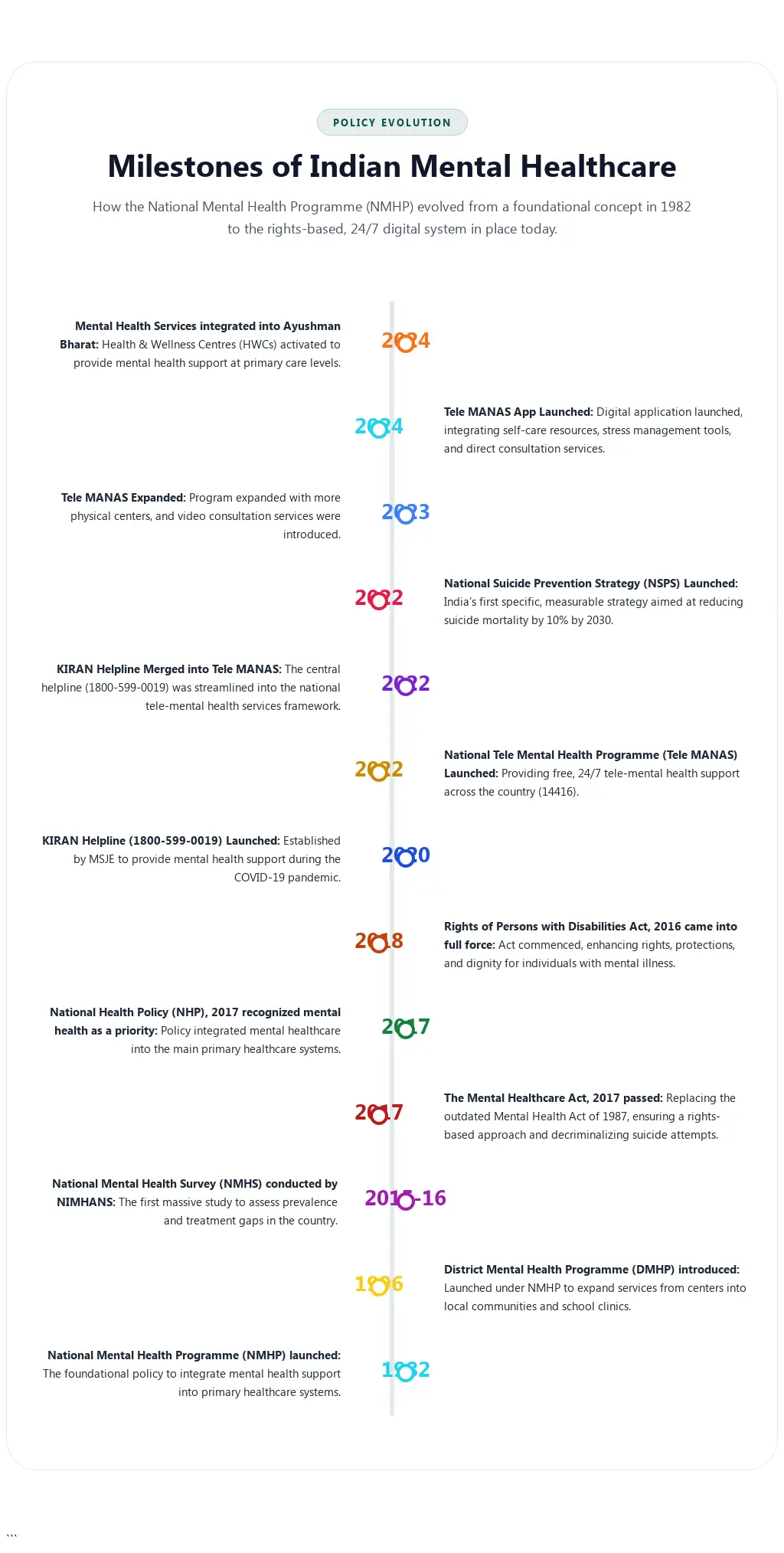
40+ Years of Progress: A Review
Government policies, district services, and digital platforms are now integrated. The journey from policy concept to rights-based care is mapped below.
🔍 Our Key Perspectives
📈 What Is Working
⚠️ Needs Attention
“Services exist. But awareness, accessibility, and trust are still catching up.”
Government initiatives have created a strong foundation. Mental health systems succeed only when people know they exist and feel safe using them.
Common Questions about Mental Health in India
India’s mental health story is no longer about silence. It’s about survival and strength.
We have moved past the era of hidden asylums and “medieval” care. Today, from the village blocks of Uttarakhand to the metros of Mumbai, a new generation is speaking up. Whether it’s through the 24/7 support of Tele-MANAS or the grassroots empathy of the Suno Na Initiative, the message is clear:
Help is no longer a privilege it is a right.
Be a Gatekeeper of Hope
You don’t need to be a doctor to save a life. You just need to listen.
Our Commitment to Accuracy
This report synthesizes a vast range of national policies, NIMHANS data, and field insights from the Suno Na Initiative. While the Healthy Knots Team has rigorously verified and cross-checked every statistic to ensure 2026 standards, we believe in constant improvement.
✉️ Spot a detail that needs an update? Let us know at:
hello@healthyknots.com